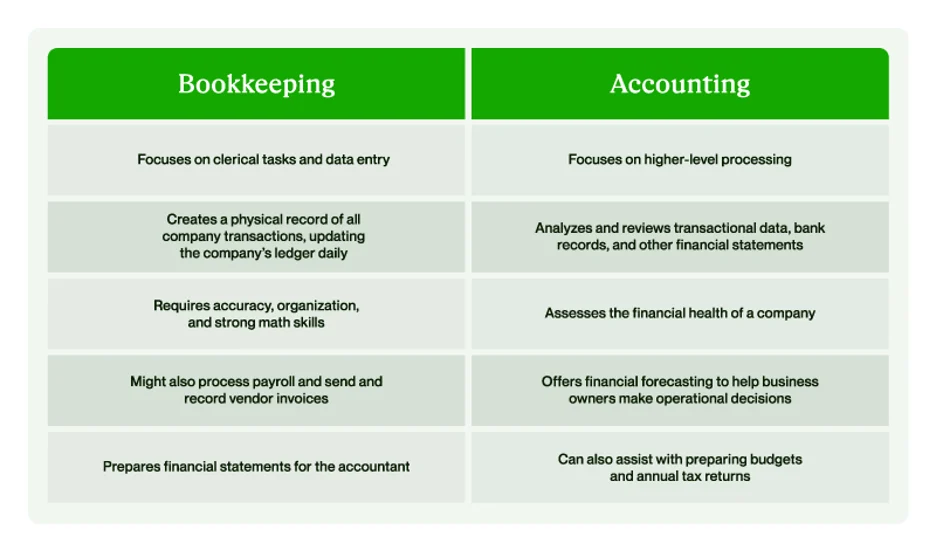
People use these two terms interchangeably all the time, and honestly, it’s a fair mistake. But the bookkeeping vs accounting distinction matters more than most business owners realize, especially when deciding who to hire and when.
I’ve seen small business owners hire an accountant for daily transaction entry — expensive and unnecessary — when a bookkeeper would’ve done the job just fine at a fraction of the cost.
What Bookkeeping Actually Involves
In brief: Bookkeeping is the day-to-day recording of financial transactions — sales, purchases, receipts, payments — forming the raw data that accounting later analyzes and interprets.
A bookkeeper’s typical responsibilities include:
- Recording daily sales and expenses
- Managing invoices and payment tracking
- Reconciling bank statements
- Maintaining organized financial records
It’s largely administrative, though accuracy here matters enormously — bad bookkeeping creates bad accounting downstream, no matter how skilled the accountant is.
What Accounting Actually Involves
Accounting takes the raw data bookkeeping provides and turns it into meaningful financial insight — profit and loss statements, tax filings, financial forecasting, and strategic advice.
In brief: Accounting involves interpreting, summarizing, and analyzing financial data to produce reports, ensure tax compliance, and support business decision-making, going well beyond simple record-keeping.
[link to related guide on basic accounting principles here]
Skill and Qualification Differences
Bookkeepers typically don’t need formal certification, though many pursue courses for credibility. Accountants, especially Chartered Accountants (CAs) in India, undergo rigorous formal training and certification before they can legally sign off on audits or certain filings.
This distinction matters when you’re hiring — if you just need transactions recorded accurately, a qualified bookkeeper is sufficient and considerably cheaper than a CA.
Cost Differences You Should Know About
I’ve noticed business owners often overpay by hiring a full accountant for tasks a bookkeeper could easily handle. In India, bookkeeping services typically cost a fraction of what a Chartered Accountant charges for the same volume of transaction entry.
- Bookkeeper: focused on transaction accuracy, lower hourly cost
- Accountant: focused on analysis, compliance, and strategy, higher cost but broader value
[link to related guide on business registration process here]
When You Need a Bookkeeper vs an Accountant
In brief: Small businesses with straightforward operations often need a bookkeeper for daily records and an accountant only periodically — for tax filing, financial statements, or major decisions — rather than full-time.
Has this happened to you — hiring expensive help for something that turned out to be pretty routine transaction entry? It’s a common early business mistake.
Alt text suggestion: “Bookkeeper organizing financial records compared to accountant analyzing reports”
Can One Person Do Both Jobs?
In smaller businesses, yes, often the same person handles both bookkeeping and basic accounting tasks, especially early on. As the business grows, it usually makes sense to separate these functions, since accounting requires more strategic time that daily bookkeeping tasks can crowd out.
Software Has Blurred the Line Somewhat
Tools like Zoho Books, Tally, and QuickBooks now automate much of traditional bookkeeping, which has shifted many bookkeepers toward more analytical tasks that once belonged strictly to accountants. This overlap is only going to increase further.
FAQ
Is bookkeeping the same as accounting? No, bookkeeping is the recording of daily transactions, while accounting interprets that data into reports, tax filings, and strategic financial insight.
Do small businesses need both a bookkeeper and an accountant? Not always full-time — many small businesses use a bookkeeper regularly and bring in an accountant periodically for tax filing and financial review.
Which is cheaper, bookkeeping or accounting services? Bookkeeping services are generally cheaper since they involve routine data entry, while accounting requires higher qualifications and strategic analysis.
Can a bookkeeper file my business taxes? Generally no, tax filing typically requires a qualified accountant or Chartered Accountant, especially for anything beyond very basic returns.
Is accounting software replacing the need for bookkeepers? Partially — software automates routine entry, but businesses still often need someone to manage exceptions, reconciliations, and data accuracy.
Conclusion
Understanding bookkeeping vs accounting helps you hire the right help at the right cost, instead of overpaying for services you don’t actually need yet. Bookkeeping keeps your daily records straight; accounting turns those records into decisions you can actually act on.
If you’re just starting out, get your bookkeeping sorted first and bring in an accountant when tax season or bigger financial decisions come around.